
How Calibration Works
Every day you log weight and food, Tracked compares what you ate to how your weight actually moved — and solves for the calorie burn that explains the difference.
- Uses the energy balance equation: intake minus expenditure equals stored energy
- Needs at least 14 days of paired weight and food logs to calibrate
- Runs on a rolling 28-day window so recent trends carry more weight
- Falls back to the Mifflin-St Jeor formula when data is too thin
Confidence That Grows With You
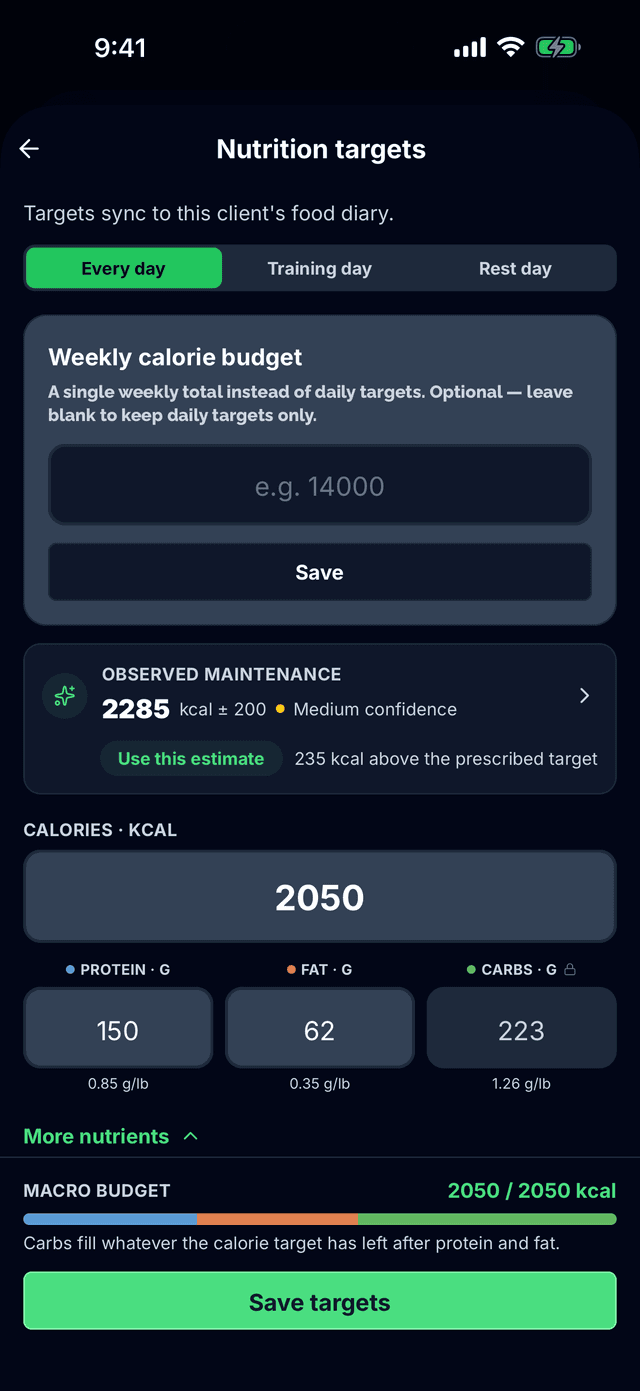
The more consistently you log, the tighter Tracked's estimate gets. A confidence level and calorie range travel with every number so you know how much to trust it.
- High confidence (±100 cal) once logging consistency passes 80%
- Medium confidence (±200 cal) blends your calibrated number with the formula
- Low confidence (±300 cal) leans on the formula until you've logged enough
- Partial-tracking days are automatically excluded so they don't skew the average
Watch Your Expenditure Move Over Time
A single number is a snapshot. Tracked plots your expenditure week over week, smoothed to filter noise, so you can see how a cut, a bulk, or a new training block actually shifts your metabolism.
- Weekly-stepped trend line built from rolling 28-day back-calculations
- Smoothed with the same DEMA algorithm used for your bodyweight trend
- Shows a floor-to-ceiling confidence band around every point
- Surfaces your average logged intake alongside each week's estimate
Smarter Than a Flat 7,700
Most calculators assume every kilogram of weight change costs the same 7,700 calories. Tracked adjusts for how fast you're gaining or losing and which direction you're moving, since fast changes and slow changes aren't stored the same way.
- Rate- and direction-aware stored-energy calculation, not a fixed constant
- Accounts for the different energy density of fat versus lean tissue
- Recalculated automatically as your weight trend updates
- Same math that powers your nutrition targets, kept in sync
Not Logging Yet? Start With the Formula
Get a Mifflin-St Jeor estimate in seconds with our free calculator — then download Tracked to let your real data take over.
Try the TDEE Calculator