Scientific Progressive Overload Tracker: Evidence-Based Approach
How progressive overload actually drives strength and hypertrophy, what the research says about applying it, and how to track it without manual spreadsheet math.
Scientific Progressive Overload Tracker: Evidence-Based Approach
Progressive overload — systematically increasing the demand placed on your muscles over time — is the single most well-established principle behind long-term strength and hypertrophy gains. It's also the easiest principle to claim you're following and the hardest to actually verify without a tracker that does the comparison for you.
What the research says
The ACSM Position Stand on Progression Models in Resistance Training recommends a 2–10% load increase once you can complete one to two reps beyond your target rep range for a given weight. The NSCA frames it more simply: the training stress in a given session should exceed the stress from the previous one, whether that comes from more load, more sets, more reps, or less rest. Their practical shorthand is the "2-for-2" rule — if you beat your rep target by two or more reps across two consecutive sessions, increase the load.
Volume matters too. Schoenfeld et al. (2017) found each additional weekly set per muscle group associated with measurable additional hypertrophy, and Krieger's (2010) meta-analysis showed the effect size climbing from 0.24 (1 set) to 0.44 (4–6 sets) before plateauing. And proximity to failure is part of the equation: a 2024 meta-regression by Robinson et al. found hypertrophy improved as sets got closer to failure — which is why overload isn't just "add weight," it's "add weight, reps, sets, or effort, tracked consistently enough to know which one moved."
Every one of those recommendations has the same prerequisite: you have to know what you did last time. That's the part a tracker solves.
Why manual overload tracking breaks down
The "2-for-2 rule" sounds simple until you're trying to apply it across 6–10 exercises a session, 3–5 sessions a week, for months. In practice, manual tracking (spreadsheets, notes apps, memory) fails in a few predictable ways:
- You forget the exact numbers. "About 185 for 8" isn't the same input as "182.5 × 8 at 1 RIR" when you're deciding whether to add weight.
- You compare the wrong sessions. Overload should be judged against the last time you did that specific workout, not just your last gym visit — those are rarely the same session if you're on any kind of split.
- You don't factor in effort. Hitting the same reps at a much higher RIR than last time is still progress, even if the weight didn't change — see RIR Tracker for why proximity to failure is part of the overload signal, not separate from it.
How Tracked automates progressive overload tracking
Tracked's Net Progression feature is built specifically to remove the manual comparison step. Every time you finish a session, Tracked automatically compares it to the last time you performed the same workout and returns a single, clear signal: up or down — factoring in weight, reps, sets, and RIR together, not just the top-line numbers.
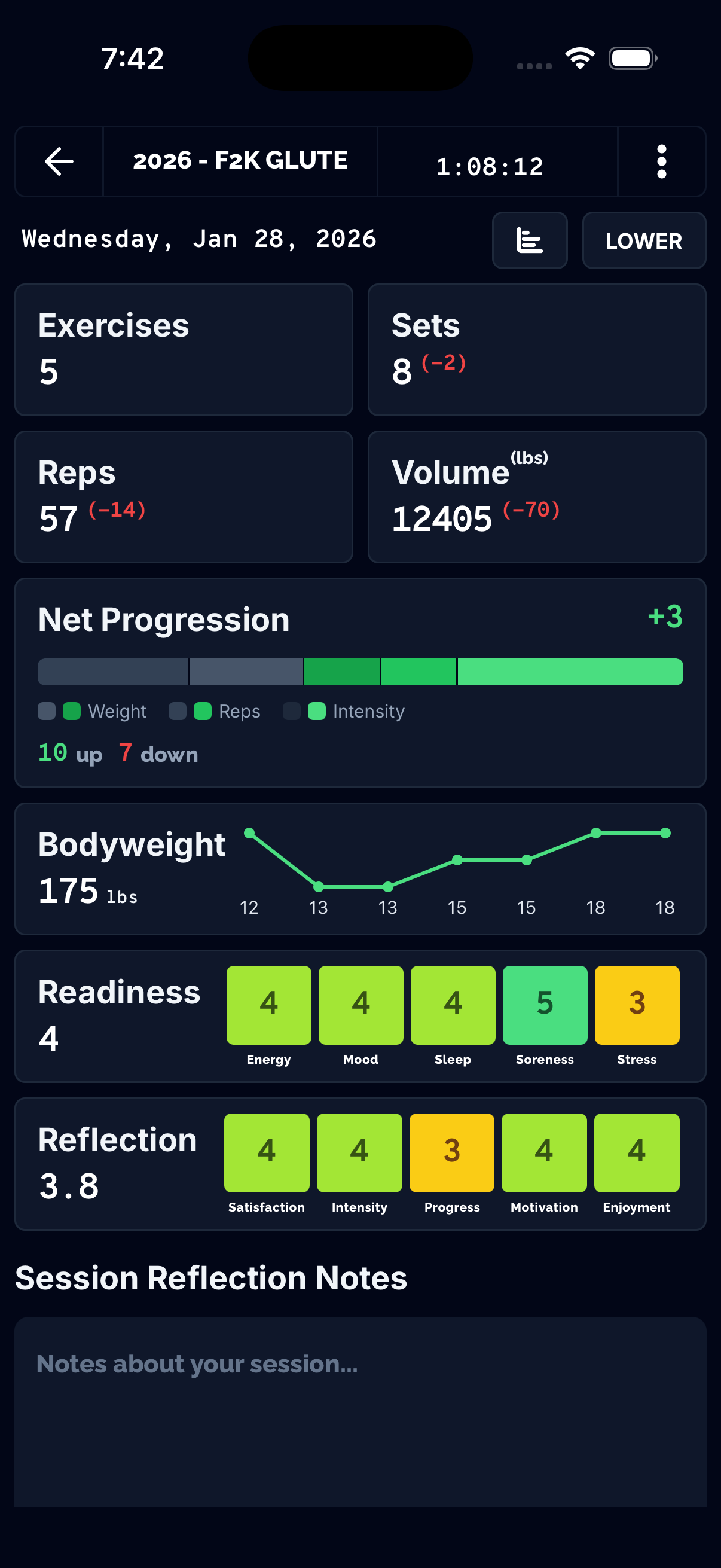
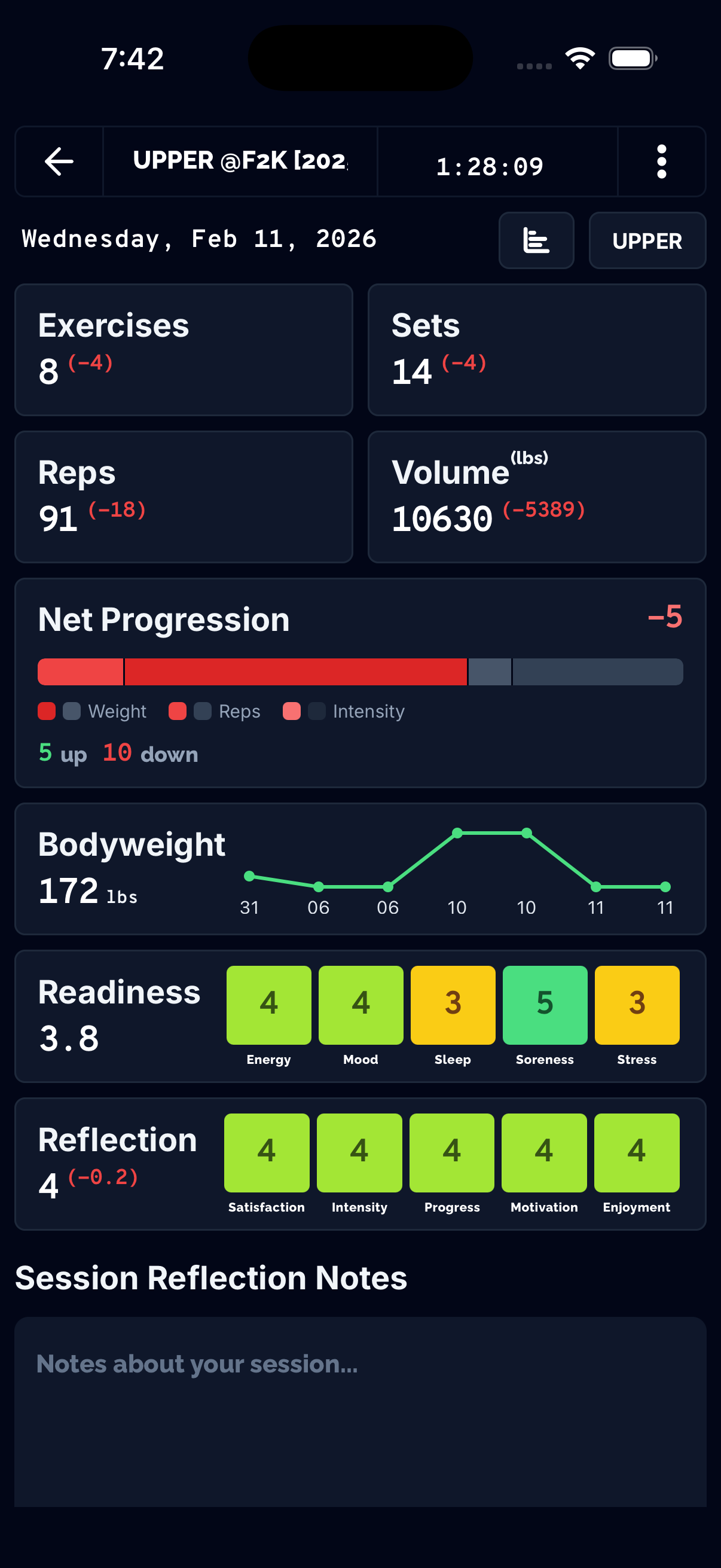
Alongside that session-level view, Personal Records tracks your best performance per rep range, so "am I stronger at 8 reps than I was two months ago" is a lookup instead of a spreadsheet formula — and Muscle Analytics rolls individual sessions up into weekly volume per muscle group, so you can check the "add sets" lever, not just the "add weight" lever, against your actual training history.
Applying the 2-for-2 rule with a tracker
- Set a target rep range for each exercise (e.g., 6–10 reps).
- Log every set with weight, reps, and RIR — the RIR is what tells you whether a rep-range hit was earned or a grinder.
- Check Net Progression after each session instead of trying to remember last time's numbers.
- When you beat your target by 2+ reps for two consecutive sessions, add load — Personal Records will confirm whether that's also a genuine PR for the rep range.
- Zoom out weekly with Muscle Analytics to check whether volume, not just load, needs to increase for a lagging muscle group.
For the psychological and physiological mechanism behind why having a concrete number to beat matters this much, see How Tracking Your Lifts Drives Muscle Growth. For how progressive overload fits into the bigger workout-tracking picture, start at the complete workout tracker guide.
References
- ACSM (2009). Progression models in resistance training for healthy adults. Medicine & Science in Sports & Exercise, 41(3), 687-708. PubMed
- NSCA (2015). Foundations of fitness programming. NSCA PDF
- Schoenfeld, B.J., Ogborn, D. & Krieger, J.W. (2017). Dose-response relationship between weekly resistance training volume and increases in muscle mass. Journal of Sports Sciences, 35(11), 1073-1082. PubMed
- Krieger, J.W. (2010). Single vs. multiple sets of resistance exercise for muscle hypertrophy: a meta-analysis. Journal of Strength and Conditioning Research, 24(4), 1150-1159. LWW
- Robinson, Z.P., Pelland, J.C., Remmert, J.F. & Refalo, M.C. (2024). Exploring the dose-response relationship between proximity to failure and muscle hypertrophy: a meta-regression. Sports Medicine. PubMed